


Amaron Battery vs Standard Batteries: What Should Dubai Drivers Know?

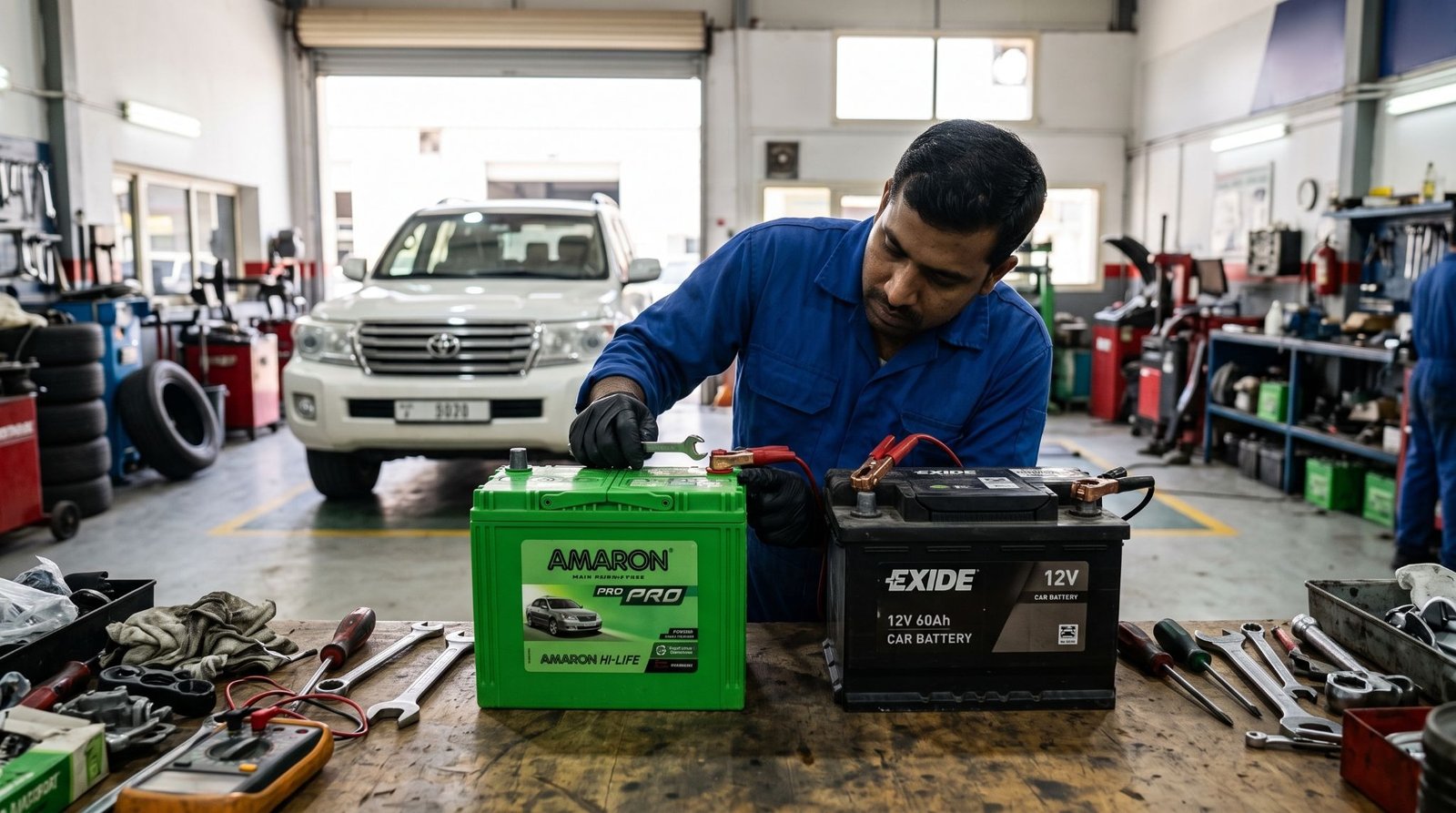
Walk into any battery shop in Dubai and you’ll usually be offered two kinds of answers: a basic, budget-friendly battery, or a premium option like Amaron that costs more upfront.
Most drivers default to whichever one is cheaper without really understanding what they’re giving up or paying for. Here’s what the difference actually comes down to.
The Short Version
If your car sits outdoors in Dubai heat, does mostly short city trips, or you’d rather not think about your battery until it’s time to replace it, Amaron’s sealed, heat-resistant design tends to justify the extra cost.
If your car is older, driven gently, and parked in shade or a garage most of the time, a standard battery can still get the job done at a lower price. The rest of this comes down to why.
What “Standard” Actually Means Here
A standard car battery is typically a basic flooded lead-acid unit, the same core technology that’s been used in vehicles for decades.
It works by allowing electrolyte fluid to flow freely around lead plates, which is straightforward and inexpensive to manufacture, but also more vulnerable to heat, evaporation, and gradual internal wear than newer sealed designs.
This isn’t necessarily a bad battery. It’s simply a baseline one, built to do the job without the additional engineering that goes into heat-specific or maintenance-free alternatives.
Where Amaron Pulls Ahead
The gap between Amaron and a standard battery shows up most clearly in three areas.
- First, heat handling: Amaron’s silver-calcium alloy plates and sealed VRLA construction significantly slow the evaporation and corrosion that Dubai’s summer heat accelerates in a standard flooded battery.
- Second, maintenance: Amaron batteries are fully sealed, so there’s no water top-up or fluid checking required, something standard batteries in older, vented designs may still need.
- Third, and often underrated, is recovery from short trips.
Amaron batteries are built to recharge faster once the engine is running, which matters in city driving where the car rarely gets a long, uninterrupted stretch to fully recharge.
A standard battery under the same driving pattern tends to fall behind on charge more easily over time.
Where a Standard Battery Might Still Be Fine
None of this means a standard battery is a poor choice in every situation. For an older vehicle without high electrical demands, driven occasionally and stored somewhere shaded, a standard battery can perform reasonably well for a couple of years without the premium price tag.
Budget matters too. If a standard battery gets a car through its remaining useful life without major issues, spending extra on a premium option doesn’t always pay off, particularly for a vehicle nearing the end of its own service life anyway.
The Real Cost Comparison Over Time
This is where the upfront price difference gets more complicated. A standard battery in Dubai’s climate often lasts closer to two years rather than the three to five years quoted for milder climates, since heat accelerates wear regardless of brand.
Amaron’s heat-resistant construction is built specifically to slow that acceleration, which can mean fewer replacements over the same stretch of ownership.
Warranty terms reflect this difference too. Amaron typically carries a longer local warranty than budget standard batteries, which adds a layer of protection that a cheaper battery usually doesn’t include.
How to Decide for Your Specific Car
The decision gets easier once you factor in your actual vehicle and driving pattern rather than price alone. Newer cars with higher electrical loads, frequent short trips, or outdoor parking tend to benefit the most from Amaron’s heat and cycle-life advantages. Older, simpler vehicles driven occasionally may not need that extra performance margin.
If you’re ready to make the switch, sourcing a genuine Amaron Battery in Dubai is straightforward through a trusted workshop, where technicians can confirm the right fitment for your specific make and model before installation.
Conclusion
Amaron versus a standard battery isn’t really a question of which one is universally better, it’s a question of which one matches how your car is actually used.
For most daily drivers in Dubai’s heat and traffic, the extra investment in a heat-engineered battery tends to pay for itself in fewer replacements and fewer surprises.
For a car with modest demands and gentle use, a standard battery still has its place.